Search

Google
Showing posts with label Financial. Show all posts

Monday, July 12, 2010

Overtrade to Improve Mileage?


Confused SG Driver has requested for advice via comment on my earlier post Overtrade for a New Ride?

Confused SG Driver said...
"Hi,
As mentioned by many other visitors to your blog, the information you have presented here is truly useful and concise!

And like many people who visit your blog, I'm currently looking to upgrade my present car. However, I'm not that great with detailed numbers and am perhaps not very adept at translating the full meaning and implications of the data which were calculated after entering them into your most detailed "used car" spreadsheet. As such, my present situation is like so:

1)I currently drive a second hand Mazda 3. I purchased this last year October (10/2009) at a price of $34k. My current monthly installment is $550 and my current mileage is approximately 79k. It was originally registered in 2005 october.

2)I understand that it sounds silly to sell my present car being that I have only bought it less than a year ago.However, I made the mistake of purchasing a '05 mazda 3 which has a appalling Fuel consumption of 10.4km/l, at best. I am in sales and drive alot, having to pump approximately 5 to 6 full tanks of 92 grade petrol at SPC for a cost of approx $70 to $80 per tank PER MONTH.

3)I am looking at a second hand 2009 Toyota Allion which has a highly praised Fuel consumption of around 15 to 17km/l.
A dealer has offered me a trade:To sell my Mazda 3 at $28k(being car paper value of 21k), and a buy of their second hand '09 Allion with a low mileage of less than 20k at a pice of $60k. I am also may be looking at a over trade of around $5k to help to settle all the administrative fees and requirements

So my question would be:

1) Would it be a good time to buy and sell right now(being that all cars are now inflated due to the high COE bidding)? Or should I wait further?

and If I waited further would I lose more money due to petrol costs (or touch wood maintainence costs) of the high fuel consuming Mazda 3?

And also, should I believe the car agent who tells me that ,should I choose to wait till October, they would only be able to export it and thus only be able to offer me much less for it?

Or

Should I buy the Allion in a moment of insanity, how long would I have to drive it before selling it in the future?Would it also make it doubly hard on me to sell it then being that I bought it at a high COE value peroid?

Thank You very much,
Confused SG Driver. "

I empathized the situation that you are currently in.  At the end of the (business) day, the dealer will only survive if there is business transaction.  Thus, you can tell your story to a dealer and almost every one of them can come up with a deal for you.  The key point is that you should make a proper financial analysis of the deal rather than an emotional one which you may experience a second regret.

Although you only numbered one question, I find many question marks in the final paragraph LOL.  I will attempt to answer each of them.

Q: Would it be a good time to buy and sell right now(being that all cars are now inflated due to the high COE bidding)? Or should I wait further?
Unfortunately, I am not Paul the Octopus and thus, cannot predict with 100% accuracy where the COE quota premium is trending in the future.  If you are buying and selling in back-to-back transactions, then almost anytime is fine since you either "buy low sell low" or "buy high sell high".  The real question is whether you really need to change your ride.


Q: and If I waited further would I lose more money due to petrol costs (or touch wood maintenance costs) of the high fuel consuming Mazda 3?
Petrol and maintenance costs are operating costs that you need to incur when you own a car.  I don't think you are losing more money unless you do your sums and prove that you spend more per month over the useful lifespan of the Mazda 3.


Q: And also, should I believe the car agent who tells me that ,should I choose to wait till October, they would only be able to export it and thus only be able to offer me much less for it?
Talk is cheap so you should based your computation on the paper value of the car, any trade-in quote by the dealer is just a bonus to you in lowering your cost of upgrading.  You may want to also check out online advertisements for used cars similar to the age and make of your ride.  The dealer will attempt to sell it at a good profit before exporting the car if it cannot be sold.  He will always take the most profitable (or most cost recovered if he made a bad call on a deal) route for himself. 


Q: Should I buy the Allion in a moment of insanity, how long would I have to drive it before selling it in the future?Would it also make it doubly hard on me to sell it then being that I bought it at a high COE value period?
Haha, I don't think you should doing anything rash if you are in moments of insanity.  The paper value of the car stays the same whether it is a high or low COE value period so that is how much the operating cost of the car should be computed.  If the question is how long you need to drive before selling the car without any cash top-up, you can see my post on When is Your Ride Breaking-Even?


Here is how I would recommend that you do your analysis:

1. Compute your monthly financial cost of ownership of the Mazda 3 for two scenarios:
a) the full useful life and add the fuel cost of $80x6 (worse case)
b) till the point of trade-in and add the fuel cost of $80x6 (worse case)

2. Compute your monthly financial cost of ownership of the Allion, including the overtrade amount and fuel cost (expected based on your optimistic assessment)

If you have all the number crunched, you can then make the decision based on the monthly cost of the Mazda 3 over the six years or the combined monthly cost of (1 year Mazda 3 usage plus 9 years Allion usage).

However, I have to warn you that the monthly operating cost is not realized until you fully used the car for its lifespan or when you sell the car.

Without all the actual numbers, I can only advise you to consider the additional fuel cost of the remaining 5 years of the Mazda 3.  Based on optimistic fuel saving of 1/3, you will save 1/3x$480 per month = $1,920 over the five years = $9,600.  Does it make sense if you are going to incur the $5,000 overtrade, loan prepayment penalty and other costs?  Yes, you may improve your mileage but you should also make sure the change will improve your financial health.

I hope this helps.  Please also read the following relevant posts for more insight.

Related posts: Lowering Cost of Ownership, Overtrade for a New Ride?, When is Your Ride Breaking-Even?


Thursday, March 26, 2009

Used Car versus New Car


Anonymous said...
"Hi Skxly,

Great to come across your blogs, you did a very good job on providing us the very useful infos and tools :) I'm looking for a cheaper car as my daily transport for working, i don't care whether it's used car or new car as long as it's cheaper.

I'm a new learner on buying car. Would you mind to give me opinion among 2 cars below, which one is value to buy?

USED CAR
========
Date Posted 18-Mar-2009
Ad ID CAR-28873
Expiry Date 10-Jul-2009
Description
Make & Model Kia Picanto GL 1.1

Price S$ 13,500
Type Hatchback

Engine Capacity 1,086 CC

Transmission Manual

Additional Information Description:

* Well Maintained And Marvellous Condition
* Accident Free
* Full Original Condition

OMV S$ 7,445
Depreciation S$ 1,705 / year
Registration Date 25/04/2006
COE N.A.
COE Expiry 24-Apr-2016
Number of Owners 1
Mileage 22,000 km

NEW CAR
=======
Price:
S$ 29,999
Last Updated:
05 Mar 2009
COE (CAT A):
S$ 4,890 (Last updated: 04 Mar 2009)
Monthly Instalment:
N.A.
Vehicle Type:
Hatchback
Engine Capacity:
1,086 CC
Transmission:
Manual

The price showned in USED CAR ad is the total price that I need to pay? Does it include the COE? I find quite confusing to read the ad.. Need separate MOV payment or it alraedy included in the price stated? If the Total price is 0k or below, i plan to pay by cash.

Otherwise, anything above 20k i need to take up loan. The new car price included COE? The ad states price is inclusive of registratration, road tax, etc.. But i dunno the registration meant for COE or not."

skxly:

Well, a used car should always be cheaper than a brand new car since the valuation will fall steeply in the earlier years of usage. The other exception is when COE quota premium increases offset the depreciation.

You should check with the used car dealer about the advertisement and get the breakdown details of all payment components. One additional payment for used car is the transfer fees payable to LTA. The price $13,500 does not result in a depreciation of $1,705 over 7 years; it should be $1,397 if $13,500 is the final price you pay. I believe that $1,705 includes the loan interest, transfer fees and others.

If you buy the Picanto new, your depreciation is $2,628 per year over the 10 years. Your consideration should be centered on the condition of the used car. If it is very road worthy and free of maintenance trouble, the used one is an obvious choice from the economic perspective. You can use the tool at my blog post Total Cost of Ownership to understand how much you will have to spend on each option.

Hope this helps. Remember that you have to pay a premium to have a new car...

Saturday, February 28, 2009

Can I Afford a Car?


This is a frequently asked question on many local motoring forums. I am surprised if any of the topic starter actually rely fully on the responses to make the buying decision. There are many tools to compute depreciation, paper distribution, motor loan repayment schedule, etc. but I could not find a good tool to analyze the Total Cost of Ownership including ongoing operating costs. Thus, I had embarked on a mini project back in October 2007 to study the Total Cost of Ownership (see the site on Wordpress) for motoring in Singapore. However, I did not get many responses and therefore, the idea was sitting on the backburner for quite some time.

Earlier this week, I got inspired and managed to put the tool together in a few hours. These are the components that I take into consideration:

1. Loan Instalment

2. Road Tax and Radio License - road tax can be computed from the formula at www.onemotoring.com.sg and radio license is $27 per annum as given at www.mda.gov.sg. Adhoc rebates from the government is not reflected.

3. Motor Insurance - annual insurance premium with No Claim Discount of up to 50% can be computed. The estimation is assuming that the annual premium stay constant and no accident occur so the NCD will increment each year up to 50%.

4. Fuel Cost - monthly cost is computed from the average mileage x fuel price x fuel consumption of the vehicle. You can estimate the monthly mileage from the regular destinations (eg. home to office to home on working days) and some buffer for weekend and adhoc trips.

5. Servicing - maintenance of the motor vehicle is necessary every 10,000km so estimated servicing cost is added every 10,000km driven. However, one standard cost is used for the estimation as different costs per 10K, 20K, 30K, etc. servicing cannot be easily captured.

6. Parking - monthly season parking charges, average coupon costs and adhoc parking costs can be estimated.

7. Electronic Road Pricing - monthly ERP charges can be estimated (www.onemotoring.com.sg) with some buffer.

8. Cleaning and Grooming - package cost or allowance for car washes can be estimated.

9. Inspections - required for vehicles at age 3, 5, 7 and 9 years. Inspection cost is taken from VICOM (www.vicom.com.sg).

10. Others - tyre change, in-car entertainment system upgrade and adding other accessories.

The tool can help the new motorist understand the Total Cost of Ownership and the schedule of cash flow needed to fund the operation of a motor vehicle. The tool is also useful to the seasoned motorist as a log to record the actual cost incurred for each component. Do note that once an actual cost is entered, it will overwrite the formula in the cell and you will need to download the tool and start from scratch again if you need to revert to the original numbers. Please feel free to provide me with your feedback of the tool.

Ready to test drive the tool? Click here to proceed.

Saturday, December 13, 2008

Fair margin for the Dealers?


How lucrative is the auto sales business? You can get the cost of new cars registered in the previous month from the LTA website.

The basic cost that dealers must pay includes:
1. OMV - Open Market Value. OMV is assessed by the Singapore Customs, based on the price actually paid or payable for the goods when sold for export to the country of importation. This price includes purchase price, freight, insurance and all other charges incidental to the sale and delivery of the car to Singapore.
2. Custom Duty - 20% OMV
3. GST - Goods & Services Tax 7% (OMV+Custom Duty)
4. ARF - Additional Registration Fees 100% OMV
5. Registration Fees - $140
6. COE cost

Thus, the difference between the selling price and the basic cost of the car is the margin including Selling, General and Administration Expenses (SG&A). Some of the expenses that I presume are the operating cost of the showroom, basic salary and commission for the sales team, marketing/advertising and the regular overheads of a business.

I checked on a few popular makes and models to see how much margin the authorized dealers make. Here are some interesting statistics for the month of November:

Honda Civic 1.8MT
Average OMV=$22,178
Total Basic Cost=$59,096
Selling Price=$74,000
Margin including SG&A=$14,904

Hyundai Avante 1.6A
Average OMV=$11,911
Total Basic Cost=$37,800
Selling Price=$52,999
Margin including SG&A=$15,199

Mazda 3SP
Average OMV=$15,308
Total Basic Cost=$45,558
Selling Price=$61,188
Margin including SG&A=$15,630

Mitsubishi Lancer 1.5 MIVEC GLS
Average OMV=$17,701
Total Basic Cost=$51,024
Selling Price=$58,588
Margin including SG&A=$7,564

Nissan Latio CVT 1.5L
Average OMV=$17,523
Total Basic Cost=$50,618
Selling Price=$59,500
Margin including SG&A=$8,882

Subaru Impreza 5D 2.0R-S AWD
Average OMV=$15,540
Total Basic Cost=$43,934
Selling Price=$61,388
Margin including SG&A=$17,454

Toyota Altis 1.8 Auto
Average OMV=$18,584
Total Basic Cost=$50,887
Selling Price=$63,988
Margin including SG&A=$13,101

I also scan through the list to see what is the lowest margin - it is just $1,867 for the Chery QQ 0.8L. The margin for the premium makes is even greater but then, the SG&A is proportionally higher. The pricing of cars depends on the business strategy of the dealer. If the dealer has a strong after sales servicing business, lower selling price may be used to increase the population of the make to generate higher revenue for its servicing business. Buyer may opt to purchase from Parallel Importers to save some money with a lower pricing but have to bear the risk of complications dealing with a small business. See the tales of the $2 COE for an example.

So do you think the dealers are making a fair margin? One idea is DIY - maybe our non-profit motoring associations may consider helping members to buy direct from manufacturers and bid for the COE.

Sunday, November 23, 2008

Tales of the $2 COE


The $2 Category A COE Quota Premium in the 2nd bidding exercise in November has brought a wide spectrum of reaction from motorists, dealers and the public. If you visit some of the motoring forums, you will come across interesting discussions about this freak bidding result.

The Happiest group
Buyers who were given a high COE rebate realized major savings to what they thought they are going to pay for their new rides. The highest rebate level that I know was $10,000 so the lucky buyers get a $9,998 discount.

Independent bidders should also be extremely pleased to have caught this rare opportunity of spending just $2 to get the certificate. Be reminded that $2 may not even get you pass some ERP gantries.

In-the-Middle group
Buyers who are given a low COE rebate realized some savings while the resale value of their new rides will be a lot lower compared to cars with high residual COE value.

The Angry group
Some buyers from Parallel Importers are screaming foul as the unethical dealers are not honouring verbal commitment of COE rebate. There are discussions of banding together and asking CASE to help them recover the "promised" COE rebate.

Another dozen angry persons are the bidders who had left their bid standing at $1. Think about that - they are the unlucky dozen who bidded and failed to secure a certificate.

Lesson Learned
This event has taught me an important point - NEVER neglect the details for CONTRACTS. If the purchase agreement contains all the details and includes all possible scenarios, then there should not be any conflict. Otherwise, the buyer and the dealer should cool down, sit together and try to come to a settlement without going to court and incurring hefty legal fees.

Friday, October 17, 2008

Currency Impact on Car Purchase


Anonymous said...
"Hi, would you be able to do an analysis between currency fluctuations and car prices / OMV / market / car distributors profits? With the current movement in korean / japanese currency, will be interested to know your thoughts. =)"

Well, I don't possess the knowledge and experience to make a good analysis of currency impact on those factors. I can give my layman perspective from a buyer's point of view:

1. Movement of Currency against S$
As the Korean Won has fallen against the US$ at a faster rate than against the S$, Korean cars should be cheaper now. However, there are other factors and time lack before impact from the rate change kicks in.

2. Distributors' profits
Distributors faced currency fluctuation risk but their exposure depends on the supply chain operating model. It depends on the inventory of cars being bought into Singapore ahead of the sales transactions. The distributor will be unlikely to lower the selling price if the existing stock is purchased at a higher exchange rate earlier. On the other hand, the distributor may hold the price steady even if the existing stock is purchased at a lower exchange rate - this is the case for the authorized distributor without any competition from parallel importers.

3. Profits made by Authorized Distributors versus Parallel Importers
Authorized Distributors usually have a higher operating cost to provide a better service level and also incur high advertising expense to increase the branding of the mark. The pricing strategy will also be dependent on the margin target at the point of sales versus after-sales servicing. Factors to be considered are the competitors' strategy, the availability of OEM parts and skills or technology required for servicing. The going concern of a parallel importer is an important criterion since there have been many reports of non-deliveries due to financial health and fraud - do your homework first before buying from the P.I.

I don't think you can time your purchase to an advantage of currency impact since there are so many variables in the motoring market. Affordability and suitability are more important criteria. Hope this is helpful.

Friday, October 3, 2008

Lowering Cost of Ownership


Anonymous has requested for advice via comment on my earlier post Overtrade for a New Ride?

Anonymous said ...
"tks for giving your perspective. I am in the same situation as this person. current monthly mortgage is 900+, and my car is coming to its 5th year in Dec. My car paper value is at $38k. a dealer has put together a package of both rebate and overtrade such that my monthly is lower at 900 over 7 years although I still need to come up with cash of $5k. from my perspective, it seems to make sense: I pay less per month, I have a shorter loan period (7 yrs vs 10yrs currently), and I get a new car. in this instance, would you agree that its OK?"

Based on the limited information, I can attempt to give a high-level analysis on the situation.

Assumptions:
1) I will round down your current monthly instalment to $900 for ease of illustration.
2) You did not put down any downpayment for your current ride.
3) December 2008 is the changeover to the new ride.
4) The primary objective is to lower the Cost of Ownership and there are two perspectives to that too (A & B).
5) You will use the new ride up to its full useful life of 10 years.
6) Cost of Operating the Car is not included.
7) Net present value of cash or car is not computed.

A. Overall Cost of Ownership (full usable life of the Ride(s))

Current Ride only
-----------------
Total Cost = $900 x 12 x 10 = $108,000

Cost per month = $900

Current Ride + Overtrade to New Ride
------------------------------------
Total Cost = Payment on Current Ride up to December 2008 + Full cost of New Ride

Payment on Current Ride = $900 x 58 (2 months short of 5 years) = $52,200

Full cost of New Ride = $5,000 (downpayment) + $900 x 84 (7 year loan with $900 monthly instalment) = $80,600

Total Cost = $52,200 + $80,600 = $132,800

Cost per month = Total Cost / Total Useful Lifes = $132,800 / (58+120) = $746
The denominator (58+120) is the used life of current ride + useful life of the new ride.


B. Future Cost of Ownership (remaining useful life of the Rides)

Current Ride only
-----------------
Cost per month = $900
for the next 62 months

Current Ride + Overtrade to New Ride
------------------------------------
Total Cost for next 122 months = ($900x2)+$5,000+($900x84) = $82,400
Cost per month = $82,400 / 122 = $675.41

Thus, you can yield lower monthly cost with the overtrade if all the assumptions are correct. However, you should consider these factors when making your decision:

1. Is your financial health and job security in good shape to take up this deal?
2. Is the new ride at the same or better standard to your current ride?
3. Can you use your new ride to its full lifespan of 10 years? Analysis is based on full useful life.

Point 1 is key to a happier life - you will not enjoy your ride if you are constantly struggling in paying the monthly instalment and running costs (petrol, road tax, insurance, parking, maintenance, etc). Do take the time to make that decision and not get pressured by your dealer. Good luck!

Thursday, July 3, 2008

Rebate Encashment


Extract from the LTA news release - "With effect from 1 September 2008, registered owners of un-used and valid PARF/COE rebates can apply to LTA to encash their rebates. This is an additional option available to owners. Owners who want to use their rebates to offset the upfront taxes payable for a new vehicle according to the practice today can continue to do so. LTA will continue to issue rebates to vehicle owners upon de-registration of their vehicles. The rebates will continue to be transferable and be valid for 12 months. This serves to provide flexibility to vehicle owners."

This is certainly a positive signal from LTA in response to public feedback on existing policies - the contradiction identified was that the PARF/COE rebates cannot be encashed before the policy change and used for the registration of a new car which did not support the government's goal to promote the use of public transportation and reduce the private car population.

Is the policy change impactful? I think it will achieve its purpose for FEW motorists since most of us develop the reliance on our own vehicle and the switch to public transportation for the family and ourselves is very hard once you have experienced the convenience. I would love to see our country leaders walk the talk by using public transportation themselves.

To persuade motorists to give up their cars and use public transportation, the latter should be constantly upgraded and improved so that it will be convenient for commuters to get from point to point comfortably, conveniently and on time.

Sunday, June 15, 2008

Overtrade for a New Ride?


I have receive this request from LIM Y W for advice:

"Hi, need your help to understand the relationship between overtrade, cash rebates etc in determining if its useful to buy a car. My stituation is this

- have a car coming to 5 years
- outstanding loan is still around $50k in June. unlikely to get a trade in to full redemption value at normal circumstance.

hence,
- would it be useful for me to ask for an overtrade value to offset this process of selling off my old car?
- if I combine this with the cash rebate, would it make sense?
- for cash flow, I would also look at loans 7 years or above, and maybe even 100%

so far, current car is the longest I have held onto a car. looking to selling cos am keen on other models and people have said that if I want to sell, the best time is to do so before its 5th year. If I get the right car, I would look to holding onto it for more than 3 years, maybe even 5.

any advice?"

Let me first explain the Overtrade practice by dealers. It is introduced when the MAS regulation for a motor loan limit of up to 70% of the car price was in effect. A typical scenario was that the motorist wanted to trade in his old ride for a new one but the value of his old ride was not sufficient to match the downpayment.

Example:
Value of old ride = $10,000 (market value - outstanding loan balance)
Price of new ride = $70,000
Required downpayment = 30% x $70,000 = $21,000
Maximum loan amount = 70% x $70,000 = $49,000
Shortfall = $21,000 - $10,000 = $11,000

Overtrade amount = OT
In order to meet maximum 70% loan amount, 30% x (70,000 + OT) = 10,000 + OT
Solving the equation, OT = 15,715
Inflated price of new ride = $85,715
New downpayment = 30% x $85,715 = $25,715
Maximum loan amount = 70% x $85,715 = $60,000

Thus, the trade-in value for the old ride was increased to $25,715. The difference was that the buyer had to sign up a new motor loan of $60,000 instead of $49,000; no additional cash outlay was required.

Since MAS had relaxed the rule to allow for 100% loan, the Overtrade scheme has been used to help motorists with their current ride in negative equity. What is negative equity? See my post on "When is your Ride Breaking-Even?". The overtrade scheme is essentially carrying over the outstanding loan balance after deducting the market value of the old ride to the loan of the new ride. Thus, it is a cashflow tool but it burdens the borrower with a bigger loan.

What about Cash Rebate? See my post on "A Deep Dive into the Cash Rebate scheme". Cash rebate is essentially getting cash upfront for a loan with a higher interest rate; the cash is either used to lower the purchase price or returned to the buyer.

Back to Lim's request:
1. What is the objective of getting a new ride?
Lim: "am keen on getting other models"
Lim: "If I get the right car, I would look to holding it for more than 3 years, maybe even 5."

How do you define "right car"? If your criterion is fashionable model, then all cars will not be right after newer models are out. My definition of a right car is one that takes my passengers and I to our destinations safely with a reasonable known running cost.

In my opinion, it is a very expensive lifestyle to keep upgrading to a newer model every few years. It is fine if you can afford it but using the two schemes to facilitate that will create a long-term strain on your financial health.

2. When is the best time to sell your old ride?
Cars are made to last for more than 10 years and we should strive to utilize them for the full 10 years lifespan (limited by the COE expiry). You can use the "Financial Cost of Ownership Tool" to analyze the annual depreciation. Although your old ride has higher PARF rebate up to age of five years, you have to consider the rapid depreciation in the earlier years too. You can see clearly that the depreciation rate is decreasing over time i.e. you incur less to run your ride in the later years.

I can think of some good reasons to change your old ride:
a. Heavy fuel consumption, coupled by need to drive extensively for your job - consider green cars such as the hybrid or CNG model.
b. Need major parts replacement (eg. gear box).
c. Family size has outgrown current capacity.
d. Road worthiness is a concern.

Showroom cars are always appealing and you should always think carefully over the decision for a new ride. Consider the stakeholders in the motor business:
1. Government - new car sales will help to increase our budget surplus with the "income" from COE quota premium and vehicle taxes.
2. Dealers - they will go out of business if there is no car buyer.
3. Banks - they will go out of business if there is no borrower.

Don't step into a showroom and you will avoid being tempted to change your ride. Hope this helps.


Related posts: Cost of Ownership, When is your Ride Breaking-Even?, Costly Frequent Car Refresh?, Financial Cost of Ownership for Used Car

Saturday, January 5, 2008

Financial Cost of Ownership for Used Car


I had read a recent post in MyCarForum on "How to count breakeven for 2nd hand car?" and realized that I have neglected an important group of fellow motorists who prefer to purchase used cars. The tools that I have developed till date are focused on the cost of ownership for new cars over the 10-year COE duration and cash rebate scheme offered for new cars.

The last quarter of 2007 also recorded the highest increase in inflation rate and the cost of living is expected to go up in line with the raising price of crude oil. Thus, used car is becoming a more viable option for motorists with a tight budget and a necessity to have a car in their current jobs, especially for sales and field service type of work. It is not too difficult for me to quickly modify the Cost of Ownership tool to work for a used car. Thus, two versions are available on the Cost of Ownership page:
(1) Financial Cost of Ownership for New Car
(2) Financial Cost of Ownership for Used Car

I am also working on a third version on the Operating Cost of Ownership - a project that is delayed due to my heavy travel schedule over this few months; I had targeted to launch it for the New Year.

Please try the version for Used Car and I would appreciate any feedback or bug report. Thanks.

Saturday, October 27, 2007

Project: Total Cost of Ownership


There are many fellow motorists who may have bought a car without fully understanding the total cost of car ownership over its lifecycle. This project aims to develop a spreadsheet tool for buyers to get a clear illustration of total cost of ownership after entering parameters of the desired car and also having answered questions about the expected usage pattern.


The primary goal is to educate the buyer of the initial cash outlay and the running cost on a monthly basis over the ten years of the car's life span. The issue of affordability should be tackled confidently before one commits to such a big ticket item especially if the car is going to be financed with a stretched motor loan. Failure to keep up with the monthly loan instalments may lead to a painful repossession of the car by the finance company and also residual financial woes.


I want to apply good and fair methods to estimate the cost of fuel consumption, parking, maintenance, ERP charges, etc. I believe that many of you can provide good ideas and opinion on suggested methods to make the tool a comprehensive and creditable one. I am targetting to complete it by end 2007. Click here to the WordPress project site - the end product should look somewhat like this, with an instruction page and also an input page:

Sunday, August 19, 2007

When is the Best Time to Buy a Car?


This interesting question was posted in the Carma Forum - "Is now a good time to buy car?" http://forum.carma.com.sg/showthread.php?t=1232696 which trigger a couple of different thoughts in my mind. Alan's comment is good - buy when you can afford to do so but what about choosing the timing?

I can remember the mixed feelings of motorists who bought their cars when the COE quota premium crashed to $50. While they have gotten some rebate from the purchase agreement, the dealers are the ones that are laughing their way to the bank since they have made a lot more from the lower cost of those transactions with COE rebate usually set at very low levels.

So unlike stocks, COE cannot be traded so easily and thus, it is extremely hard to time your purchase for a bottom. However, if you know that the COE quota premium is being pushed up in the recent bidding exercise, you should wait out two weeks and sign on the sales agreement when the dealers lowered their prices after a drop in the COE quota premium.

Friday, August 3, 2007

Costly Frequent Car Refresh?


There was a report "Eight out of 10 cars here less than 4 years old" in the Strait Times today. You can see the age distribution of the vehicle population on OneMotoring website http://www.lta.gov.sg/corp_info/doc/MVP01-3%20(MVP%20by%20age).pdf.

The article stated that many motorists are changing their rides every two to three years with the decreasing car price over the past few years. I agree with the reporter Christopher Tan that car price has bottomed out and seems to be on the up trend. Thus, it may not be possible for motorists to trade in for a new car and to continue with instalment payments of the same amount.

Although it is nice to be driving a new car every two years, it is an expensive habit for these reasons:
1. The depreciation rate is highest in its initial three years.
2. The Rule of 78 interest rebate gives your banker the edge on the loan prepayment.
3. The UV film, sports rims, low-profile tyres and other accessories have a much longer useful life than 2 years.
4. While one may argue that a new car will not be prone to breakdown, you are likely to send it back to the authorized service agent and thus, pay a premium for the regular servicing.

In my case, I live near my office and also travel overseas every other month. Thus, I have only chalked up much mileage when I drive up Malaysia for my holidays. My reliable MPV is now FIVE years old and the odometer only reads 94,xxx kilometres. If your mileage is low, it makes sense to stay with your ride since it is able to endure more wear and tear. The export buyers are happy to take Singapore deregistered cars as most of them are in great condition.

You can get a better understanding of the depreciation and finance cost using the Cost of Ownership tool. You should always analyze the financial commitment of upgrading to a new ride. The illustration from the dealer is always showing the average cost over ten years but the cost of ownership is not uniformly distributed. You can get an estimate of the cost of ownership based on which you are intend to sell your new ride.

Saturday, July 7, 2007

A Deep Dive into the Cash Rebate scheme


The business Objective of banks is to make money for its shareholders. So when the Cash Rebate scheme for Motor Loan was introduced, it seems too good to be true that the banks are giving back cash that they should have earned for its shareholders. How does this scheme milk money from the customers? Read on for a deep dive into the scheme.

I recently consider buying a new car to replace my aging but reliable MPV and visited several showrooms. All dealers have tied up with the banks to offer motor loans and a few offer the cash rebate scheme. Aha! The attractive low selling price advertised in the classifed is a result of deducting the cash rebate; On-The-Road (OTR) price is btween three to five thousands more.

What are the terms and conditions of the scheme? To get the cash rebate, you have to loan a principal of at least 70% of the car price for a loan tenure of at least seven years. Full refund of the rebate is required in the event of a prepayment within two years and thereafter, prorated refund of the rebate for the balanced months till the end of the loan. Rule of 78 computation with 20% penalty also applies to prepayment. A naive consumer like me will be attracted to the upfront cash rebate and overwhelmed by the good feeling of buying a car priced low aka “I bought it cheap” mindset.

How do you decide whether to sign up? It is not easy there and then. I created the first verion of this worksheet to help understand the specifics of the scheme in my earlier post. I have since updated it to Version 1.1, adding a chart for a better illustration. Please download it here as my analysis will also require you to change some parameters on the worksheet for a better understanding of the observations.

In the worksheet, the illustration is done using the Cash Rebate offer at 3.5% versus a traditional loan offer at 2.8%. You can see that the two loans have the same financial charges:
Example 1 - Cash Rebate scheme: total interest $9,800 with deduction of cash rebate $4,199 = $5,601
Example 2 - Traditional Loan scheme: total interest is $5,600

However, the loan tenure is shorter for traditional loan scheme is shorter at five years. Another key difference is that the monthly instalment is higher by $166 ($760 versus $594).

I believe that there is a large group of buyers who take loans with tenure of five years or less as Singapore residents are quite obsessed with having the latest model (similar to the trend in mobile phone ownership but to a lesser extent) and that has resulted in two-third (67%) of all private vehicles on Singapore roads is three years old or younger (source: Land Transport Authority http://www.lta.gov.sg/).

Now, turn to the Chart and see how much the buyer has to cough up - an additional sum of between $880 to $1,810 for prepayment within two years and between $450 to $600 from the third to the sixth year. What is the probability of the buyer keeping the vehicle till the seventh year? I reckon that it will be less than 30%. Thus, the banks are likely (more than 70% probability) to make more from the Cash Rebate scheme over the traditional ones as it encourages these who can afford full payment or short loan tenure or smaller loan principal to take a longer and larger loan.

This scheme is not bad and disadvantageous to the bank customer. Let me show the Effective Interest Rate (EIR) for the two examples:

Example 1 (Cash Rebate scheme) with principal of $40,000 with tenure of 7 years at 3.5% flat has an EIR of 6.44%.

Example 2 (Traditional Loan) with principal of $40,000 with tenure of 5 years at 2.8% flat has an EIR of 5.28%.
I will now introduce another buyer, probably a young working adult who endeavour to own a set of wheels but he will be putting a significant part of his monthly pay packet to finance it. He has little choice but to stretch his loan repayment period for seven to ten years. I will use an example that is easier to compare to the earlier ones - he plans to take a loan of $40,000 at 2.8% for a tenure of seven years. The total interest will come up to $7,840 and the monthly instalment is $571; his loan EIR is 5.22%

Fortunately, the Sales Engineer attending to him recommends for him to take advantage of the Cash Rebate scheme ie. Example 1. Now, change the loan period parameter for the traditional loan to seven years for a comparison or download this file. The advantage for the Cash Rebate scheme now surfaces …. see the difference in cash outlay from the 25th month (also the lock-in period). As long as he uses the car for more than two years, he will save some costs and hitting a maximum savings of $2,239 if he passes seven years. There are two impact to him:
  1. The selling price of the car is lower by $4,199 and
  2. His monthly instalment is increased by $23 from $571 to $594.
The first impact is good and he can probably stomach the second one.

We can also look at the loan from another perspective, starting from actual prepaid interest ie. $9,800 - $4,199 (rebate) = $5,601. A traditional loan with principal of $40,000 with a tenure of seven years would be at a flat rate of only 2.0% (EIR 3.79%). Can you find a flat loan rate of 2.0% these days? I must applaude the bank for being kind to its younger (or cash-strapped) customers.

At the end of the day, you should consider the loan that is most suitable to your financial needs. There is no one size that fits all. In simple and plain English, I would not recommend the Cash Rebate scheme unless you are stretching your financial capability to own the car. But the MOST important point in this post is that you will not know the actual finance cost for your car until the point of time when you sell it. I must also warn you that your financial stability is another important consideration as that may force you to sell your car premature of the loan tenure.

The two tools used in this article can help you to make a better decision - they may appear complex but once you start to plug different numbers for your possible scenarios, you will come to appreciate their usefulness. If you have read till this point, thank you for the attention … as the title has stated, this is a DEEP dive of the Cash Rebate scheme. If you come cross a new scheme which you would like me to analyze, drop me an email.

How attractive is Cash Rebate from Motor Loans?


Advertisements in the classifieds these days show cheap car prices but most of them are prices after deducting the attractive cash rebate from motor loans. Why would banks give you a chunk of its profits? Well, no business is that generous and it is likely that you will cough up more cash when you sell the car.

I have created an Microsoft Excel worksheet to compare the cash outlay between the Cash Rebate scheme versus the traditional loan. It is rather difficult to decide as the key factor to a better utilization of your loan is to use your car for at least the loan period. Get the latest version of the tool here.

At the end of the day, it depends on a few key factors:
  1. Ownership trend - if you intend to keep your car for more than the loan period, go for the rebate by all means. You should forgo the rebate if you change your car every three years or less.
  2. Deep pocket - if you can pay for your car in full, forget the rebate … but in the case that you have a good investment instrument that give returns of more than the effective interest rate (click here to see my earlier post on computing EIR) , then get the rebate and invest the sum to make additional cash.
  3. Need to Loan - if you are going to for the traditional loan (eg. 2.8% flat) without any cash rebate, you should consider the rebate scheme as you may keep your car for a longer period than anticipated and that may result in some savings.
It is not an easy decision when you are tight on cash. Good luck!

Best Measure for Cost of Car Ownership


What is the BEST measure for Cost of Car Ownership? Most buyers consider the selling price in their purchase while others may include the loan interest. These days, buying a car gets even more complex as dealers bundle insurance, loan with interest rebate and different COE bidding scheme such as non-guaranteed and guaranteed bids. You may be able to have an estimate of how much you are going to pay for your purchase but the total cost of ownership for a vehicle is really impossible to determine until you actually sell it.

After you have sold the vehicle, you would then have all the financial information such as the selling price to the used car dealer or scrap price and the balance of loan payment minus the Rule of 78 rebate and prepayment penalty. You can then compute the total incurred cost over the total number of months used to find the average monthly cost.

You can get an estimate of the monthly depreciation in my post on Cost of Ownership. Thereafter, you can compare the average monthly cost of each vehicle that you have owned and hopefully, the number is coming down as you gets wiser. However, if you have been upgrading, the number is bound to go up.

How to Compute Effective Interest Rate?


I have googled but failed to find a formula to compute the EIR for the flat interest rate usually quoted on motor loan. Most articles suggest asking the finance company or bank to provide the EIR and some stated a good estimate is EIR = 2 x flat interest rate. Is the estimate good or even fair?

Being trained in Six Sigma, I cannot help wanting to be accurate to an acceptable precision and research a little into how a banker would do that computation. I stumbled upon a template within Microsoft Excel named “Loan amortization” which is usually used for illustrating housing loan but I managed to tweak it into a tool to compute both the Effective Interest Rate and the Nominal Compound Interest Rate. There is a manual step involved to set a rate that will match the total loan including incurred interest with the assistance of an adjustment indicator. Click here to get the latest version of the tool.

Hope you will find it useful! And as usual, your comments are welcome.

Friday, July 6, 2007

Cost of Ownership


One of the biggest ticket items that one may buy in Singapore is a set of wheels to zip around the island country. However, it is extremely complex to understand what makes up the total cost of owning a car …. especially with the Certificate of Entitlement (COE) bidding, Additional Registration Fees (ARF), Motor Loans (flat rate with Rule of 78 that favours the finance company and BANKS too) , bundled Motor Insurance (expensive premium if you renew after a year without getting a competitive quote) and many other little costs that add up.

Here’s a Helplet that explains the cost of running the car over the 10 years’ validity of the COE. With the current low COE, many owners (like me) are tempted to trade-in for a “cheaper” new car ….. but, what is the amount that you are writing off on the current car? Is the trade-in value fair? The analyzer will also illustrate the effect of Rule of 78 for interest rebate when you prematurely pay up your motor loan and also the depreciation of the car over the 120 months.

I have created Version 1 some years ago and updated it to Version 2 with all the new LTA rules till date. Hope you will find it useful! Click here to get the latest version.

When is your Ride Breaking-Even?


I came across this discussion on the OneMotoring Forum and wonder if I would even break even on my car. Below are some extracts from the discussion.
The so-called ‘break-even’ date is the time when yr outstanding bank loan amount is equal or greater than the market value of yr ride (in the case of COE cars, market value = scrap value + scrap metal token $$). This is not applicable if yr ride is already loan-free.
See Ho Ee:
I am always intrigue by this ‘breakeven’ date, and how car-owners used them to decide when to change ride or get rid of their ride. Based on this definition: the breakeven date depends very much on loan amount ($) and duration (yrs).
1) If you take a loan (at 70% of total value of car for 7 years) and let this be $49k (principal + interest), repayment is $7k per year. Since PARF rebate is highest before the 5th year, it is most likely that breakeven date is ard 3 yrs.
2) If the same loan is change to 5 years tenure, the breakeven is slightly less than 2 yrs.
3) If you change this to 3 yrs tenure, the breakeven is slightly over 1 yr.
4) If you don’t take a loan, any day is breakeven.
Hence, it can be concluded that the breakeven serves no purpose. It is all about affordability. If you can afford, no loan needed. If you cannot afford, you stretch (max) your loan as long as possible. To use the residual value (PARF + COE) to pay off loan is really no brainer! It is still borrowing that you have to repay!
Therefore, back to my contention in previous posts: that buying a car of your choice all boils down to two factors:
1) falling in love with the particular made/model
2) affordability
The balanced equity point is what the non-accountants called ‘breakeven’. I had a hard time trying to understand this term as much as the terminology called ‘COE car’. I thought all cars on SG roads required COE. So if there is COE car, there must be oso be non COE car? That was what went thru my mind! Well the motoring industry is full of ‘beng’ terms. “Break-even” is a term used in economics referring to the point where the cost and the revenue is equal (also profit = zero).
For motoring, the appropriate term should be equity of the vehicle. There are three kinds of vehicle equity:
  1. Negative equity is when the amount you owe for the loan on the vehicle is more than the vehicle’s market worth. This is where dealer will offer overtrading ie. loan a larger amount than the cost of the new car to cover the prepayment on the old car.
  2. Zero equity is the point when the amount you owe on the vehicle is about equal to the vehicle’ market worth.
  3. Positive equity is when the amount you still owe on the vehicle is less than the vehicle’s market worth. Buying a car using cash keeps you in positive ground.
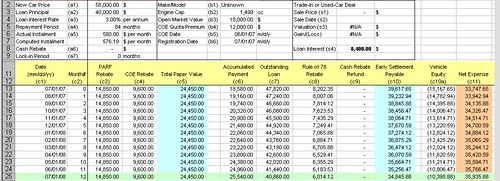
    If you are at point 1, I would not advise you to overtrade as it will put you deeper into the negative zone.
I have revised the Cost of Ownership tool to reflect the vehicle entity as well as allow the Overtrade Loan ie. Loan Amount is greater than New Car Price to settle the prepayment of the outstanding loan on the existing car. The worksheet will show you how the new ride in an overtrade deal will become a significantly negative equity …. so do consider carefully before signing on the sales agreement.